Know When Your Kidney Stone Needs Treatment
Painless but significant Kidney Stones may be dangerous, as they can damage the Kidney without any warning to the patient.
Kidney stones affect approximately 10% of people at some point during their lifetime. However, not every kidney stone requires immediate treatment. While some small kidney stones may pass naturally without causing symptoms, others can lead to severe pain, block the flow of urine, impair kidney function or result in serious infections if left untreated. Knowing when treatment is necessary is essential to prevent complications and protect long-term kidney health.

Experience: 45+
Many people have small, symptom-free kidney stones that remain unnoticed throughout their lives. These stones are often discovered incidentally during an ultrasound or CT scan performed for an unrelated medical reason. In many such cases, treatment may not be required immediately, but regular monitoring by a kidney stone specialist is important to ensure the stones do not increase in size or start causing problems.
With over 45 years of experience in treating kidney stone disease, Dr. Pawan K. Gupta believes that the decision to treat a kidney stone should always be based on the patient’s symptoms, stone size, location, risk of obstruction, infection and overall kidney function – not simply on the presence of a stone.
For better understanding, kidney stones can broadly be classified into three groups based on how they present:
At R P Stone Clinic, Panipat, Dr. Pawan K. Gupta, one of India’s most experienced kidney stone specialists, carefully assesses every patient and recommends the most appropriate treatment based on the size, location, symptoms, risk of complications and overall kidney health. This personalized approach ensures that patients receive treatment only when it is truly needed while avoiding unnecessary procedures whenever possible.
Surgical removal is generally recommended when a stone is symptomatic and unlikely to pass spontaneously affecting the kidney or causing complications.
Common situations include:
Severe pain: Pain that is intense, recurrent or not relieved by medicines usually indicates that removal may be required.
Persistent urinary obstruction: A stone blocking urine flow can increase pressure inside the kidney. Untreated obstruction may eventually cause:
Recurrent urinary tract infection: Kidney stones may become a source of repeated infections. Treatment becomes important when there is:
Blood in urine: Although kidney stones can cause mild bleeding, persistent or recurrent blood in the urine should never be ignored and should be evaluated by a urologist. If the stone does not pass spontaneously, appropriate treatment to remove it may be necessary.
Stone continues to grow: Even stones that are not causing symptoms may require removal if they continue increasing in size because larger stones become more difficult to treat later.
Reduced kidney function: Removal is recommended if the stone is affecting kidney function, especially in patients with:
Stones in both kidneys: Patients with stones in both kidneys often require early removal to preserve kidney function.
People who repeatedly develop kidney stones benefit from:
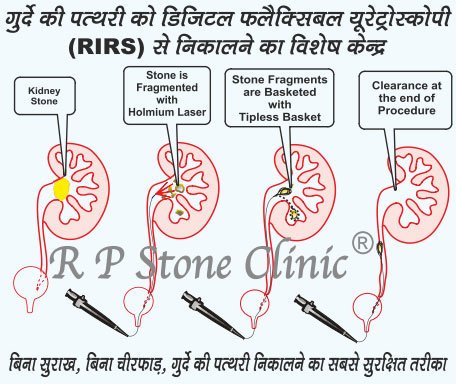
Depending on the patient’s condition, one or more of the following treatments may be recommended.
Ignoring a kidney stone may lead to:
Timely diagnosis often allows treatment before these complications develop.
Patients from Panipat, Haryana, & North India trust R P Stone Clinic because of its experience and advanced procedures.
If you have been diagnosed with a kidney stone or are experiencing symptoms such as severe pain, blood in urine, repeated infections or difficulty passing urine, a timely medical check-up is important. Dr. Pawan K. Gupta, with more than 45 years of experience in kidney stone management and as pioneer of RIRS surgery in India, offers personalized treatment using advanced technology at R P Stone Clinic in Panipat, Haryana. Contact the clinic today to receive the right advice and the most suitable treatment for your condition.
Does every kidney stone need treatment?
No. Small stones that are not causing pain, blockage, infection or kidney damage may pass naturally or simply be monitored with regular follow-up.
Can kidney stones damage the kidneys if left untreated?
Yes. Some untreated stones can obstruct urine flow, cause recurrent infections, lead to hydronephrosis and gradually reduce kidney function.
Is R P Stone Clinic empanelled with health insurance companies?
Yes. R P Stone Clinic is empanelled with several insurance providers and TPAs, including
Cashless treatment is available according to the terms and conditions of your insurance policy. Read More >>
Where is R P Stone Clinic located?
R P Stone Clinic is conveniently located at SCF – 30 and 31, near Angel Prime Mall, Huda Sector 11, Huda, Panipat, Haryana 132103 – 132103, making it easily accessible for patients from Panipat, Karnal, Sonipat, Kurukshetra, Ambala, Rohtak, Delhi NCR, Punjab, Uttar Pradesh,and nearby cities.
Who is Dr. Pawan K. Gupta?
Dr. Pawan K. Gupta is one of India’s senior kidney stone specialists with over 45 years of experience. He is a pioneer of RIRS (Retrograde Intrarenal Surgery) in India, performing this advanced procedure since 1998, and has trained numerous urologists through national and international workshops. He is widely recognized for treating simple as well as highly complex kidney stones using advanced minimally invasive procedures.
Trusted by renowned insurance companies and healthcare partners across the country.








 SCF – 30 and 31, near Angel Prime Mall, Huda Sector 11, Huda, Panipat, Haryana 132103, India
SCF – 30 and 31, near Angel Prime Mall, Huda Sector 11, Huda, Panipat, Haryana 132103, India.
Timing:Monday - Saturday :
10:00 AM – 7:00 PM
 97291 81174
 8607043191