Understand the Cost of Advanced No-Cut, No hole Kidney Stone Removal with Dr. Pawan K. Gupta
Kidney stones can cause severe pain and significantly affect your quality of life. Fortunately, with advancements in urology, it is now possible to treat most kidney stones without any external incision or hole. Retrograde Intrarenal Surgery (RIRS) is one of the most advanced and minimally invasive procedures available for kidney stone treatment today. It offers faster recovery, minimal discomfort and excellent treatment results when performed by an experienced kidney stone surgeon.

Experience: 45+
One of the most common questions patients ask before undergoing treatment is, “What is the cost of RIRS surgery?” The answer is that the cost of RIRS surgery is not fixed. It depends on several important factors, including the type of equipment used, the surgical procedure followed and the accessories required during the treatment.
At R P Stone Clinic in Panipat, Dr. Pawan K. Gupta believes that patients should clearly understand what contributes to the overall cost of RIRS surgery so they can make an informed treatment decision based on quality, safety and long-term results rather than cost alone.
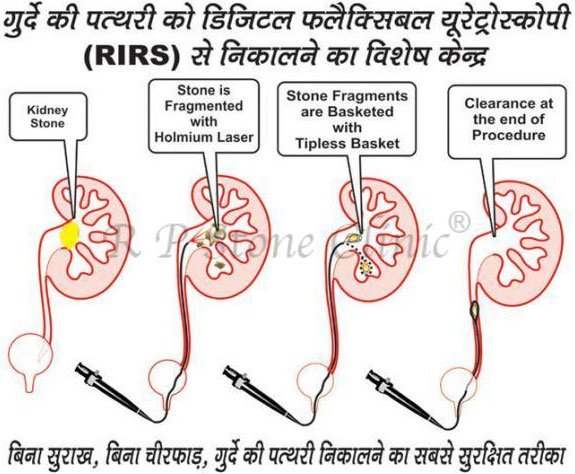
Retrograde Intrarenal Surgery (RIRS) is a modern, minimally invasive procedure performed to remove kidney stones using a specially designed flexible ureteroscope. Unlike conventional open surgery, RIRS is performed through the body’s natural urinary passage, eliminating the need for any external incision or artificial hole.
Note: This page focuses on the cost of RIRS surgery. If you would like to understand the procedure, its benefits, recovery and suitability in detail, please visit our RIRS Surgery page by clicking the link below.
Learn more about the RIRS surgery procedure, benefits and recovery.
Since no artificial hole is created in the body, RIRS is generally considered a safe and minimally invasive option when compared to other procedures for kidney stone treatment:
Because of these advantages, RIRS surgery has become an increasingly preferred treatment option for many patients with kidney stones.
Patients often compare the cost of RIRS surgery with procedures such as PCNL or Mini-PCNL. While RIRS is generally more expensive, the difference is largely due to the sophisticated technology and specialized equipment required to perform the procedure safely and effectively.
Some of the major reasons include:
We at RP Stone Clinic Pvt. Ltd. have the provision of using single use Karl Storz Flex XC1, Lasers and Imaging systems. The use of single use Digital Flexible Ureteroscope Flex XC1 will further raise the cost of RIRS procedure.
For these reasons, the cost of laser kidney stone treatment in Panipat using RIRS is usually higher than many conventional kidney stone surgeries.
The following equipment is exclusively required for RIRS procedure:
All are highly specialized and expensive medical equipment that play a major role in determining the overall cost of the procedure.
The cost of RIRS surgery may vary from one patient to another depending on several factors. One of the major factors is the type of flexible ureteroscope used during the procedure. Modern RIRS can be performed using either a fiber-optic or a digital (chip-on-the-tip) flexible ureteroscope or a single-use digital Flex XC1 and each technology differs in terms of image quality, performance and cost.
A fiber-optic flexible ureteroscope transmits images through bundles of optical fibers. While it is capable of performing RIRS, the image quality is comparatively lower than that of a digital scope. These instruments are generally less expensive, which may help reduce the overall cost of the procedure.
A digital flexible ureteroscope, often called a “chip-on-the-tip” ureteroscope, has a image sensor located at the tip of the instrument. It provides high-definition images with better illumination and clarity, allowing the surgeon to visualize the urinary tract and kidney stones more clearly. Improved vision can make stone identification , laser fragmentation & fragment removal, more precise, especially in complex cases.
Since digital flexible ureteroscopes are significantly more expensive to purchase, maintain and repair than fiber-optic scopes, RIRS surgery performed using a digital (chip-on-the-tip) flexible ureteroscope generally costs more. However, many experienced kidney stone surgeons prefer digital technology because its superior image quality enhances the treatment results.
The cost for the RIRS surgery further goes up if Single use Flex XC1 from Karl Storz, Germany is used. The type of equipment used is only one of several factors that influence the overall cost of RIRS surgery. The final cost may also depend on the size, number and location of the kidney stones, the complexity of the procedure, the hospital facilities and the patient’s overall medical condition.
The cost of RIRS surgery also depends on whether single-use disposable instruments, such as a ureteral access sheath and tipless stone retrieval baskets, are used during the procedure. These devices improve the efficiency of stone removal but also increase the overall cost of treatment.
During RIRS, the surgeon may choose one of two approaches depending on the size, number, location and composition of the kidney stones, as well as the patient’s clinical condition. In some cases, the stone is laser fragmented into very fine dust or tiny particles (dusting technique), allowing the fragments to pass naturally through urine over time. If this approach is adopted, a ureteral access sheath and tipless baskets may not always be required, which can help reduce the overall cost of the procedure. We do not recommend this technique.
In many patients, however, the surgeon aims to achieve maximum or complete stone clearance during the same procedure. In such cases, a ureteral access sheath is commonly used to facilitate repeated passage of the flexible ureteroscope while helping maintain low pressure inside the kidney. Tipless stone retrieval baskets are then used to safely remove larger stone fragments from the kidney. The use of these disposable instruments can improve stone clearance, particularly in patients with larger, multiple or complex kidney stones. The fragments can also be removed using FANS (Flexible And Navigable Suction ureteric access Sheath) technique where a bendable access sheath is used.
Both the ureteral access sheath and tipless stone retrieval basket are single-use disposable medical devices that contribute to the overall cost of RIRS surgery. They are designed to be used for only one procedure and should not be reused, as their performance and safety may be compromised after a single use. In complex cases, more than one tipless basket may be required to achieve optimal stone clearance, which can further increase the cost of the procedure.
Because these disposable instruments add significantly to the procedural cost, RIRS surgery is generally more expensive when the goal is complete stone clearance during the same operation. Likewise, RIRS performed using a digital (chip-on-the-tip) flexible ureteroscope together with single-use disposable accessories usually costs more than procedures performed without them and cost further increases if a single-use Digital Flexible ureteroscope is used like Flex XC1 from Karl Storz, Germany.
Overall, the cost of RIRS surgery varies from patient to patient. It depends on several factors, including the type of flexible ureteroscope used, whether single-use disposable instruments are required, the complexity of the kidney stones and the surgical approach needed to achieve the best possible result.
No. The cost of Retrograde Intrarenal Surgery (RIRS) varies from one patient to another because every kidney stone is different, and every procedure is tailored to the patient’s individual needs.
Several factors influence the final treatment cost, including:
For this reason, the most accurate estimate of RIRS surgery cost can only be provided after a detailed consultation, clinical examination and review of imaging investigations at R P Stone Clinic in Panipat by Dr. Pawan K. Gupta.
Advanced equipment alone cannot guarantee the best results. The experience of the operating surgeon plays an equally important role in the success of RIRS.
Dr. Pawan K. Gupta has over 45 years of experience in the field of urology and kidney stone treatment and has been performing advanced RIRS procedures since 1998. Recognized as a pioneer of RIRS surgery in India, he has organized and conducted numerous national and international workshops on RIRS, published research in reputed international journals and contributed significantly to advancements in endourology. Dr. Pawan Kuemar Gupta introduced smallest tip diameter-Ureteroscope in 2006 after conducting clinical trials in 2005. His work was published in Journal of Endourology in January 2006 under New Technologies in Endo-Urology.
Patients seeking RIRS surgery in Panipat, kidney stone treatment in Panipat, or advanced laser kidney stone surgery in North India can benefit from his extensive expertise in managing both routine and complex kidney stone cases.
If you are looking for RIRS surgery in Panipat or advanced kidney stone treatment in North India, R P Stone Clinic offers modern technology combined with decades of surgical expertise.
Why many patients choose R P Stone Clinic
Whether you have a first-time kidney stone or a recurrent or complex stone, the treatment plan is tailored to your specific condition after careful evaluation.
Choosing the right surgeon/urologist is just as important as choosing the right treatment. Rather than focusing solely on the price, patients should consider the overall quality of care, the experience of the surgeon/urologist and the technology available at the treating centre.
With decades of experience, advanced endourological expertise and modern technology, Dr. Pawan K. Gupta aims to provide safe, effective and evidence-based kidney stone treatment tailored to each patient’s needs.
If you would like to know whether RIRS surgery is the right treatment for your kidney stone or wish to receive an estimate of the expected RIRS surgery cost, schedule a consultation at R P Stone Clinic in Panipat, Haryana. After checking your medical history and scan reports, Dr. Pawan K. Gupta will recommend the most suitable treatment and answer all your questions. On 18 January 2024, during SemiLive 2024, Dr. Pawan Kumar Gupta performed an RIRS procedure that was live-streamed to Heidelberg University Hospital, Germany, demonstrating the technique of Retrograde Intrarenal Surgery (RIRS).
Is RIRS surgery worth the cost?
For many patients, RIRS offers several advantages, including treatment through the natural urinary passage without any external incision or hole, less postoperative pain, minimal bleeding, shorter hospital stay, faster recovery and an early return to daily activities. When performed by an experienced kidney stone surgeon/ urologist using advanced equipment, RIRS can provide excellent results for appropriately selected patients.
Why is RIRS surgery more expensive than PCNL or Mini-PCNL?
RIRS generally costs more because it requires highly specialized equipment such as a digital flexible ureteroscope Holmium laser/ Thulium Fiber Laser, all of which are expensive to purchase and maintain. In addition, single-use disposable instruments may be required during surgery to achieve optimal stone clearance. The advanced technology involved and the expertise required to perform RIRS also contribute to the overall cost.
Will my health insurance cover cashless RIRS surgery in Panipat?
Many health insurance policies cover RIRS surgery if it is medically indicated. However, the extent of coverage depends on your insurance provider, policy terms and eligibility for cashless or reimbursement facilities.
R P Stone Clinic is empanelled with several top health insurance companies and TPAs, including
subject to the terms and conditions of the patient’s insurance policy. It is advisable to check with both your insurance company and the hospital before admission to understand your coverage. Read More >>
Where is R P Stone Clinic located?
R P Stone Clinic is conveniently located at SCF – 30 and 31, near Angel Prime Mall, Huda Sector 11, Huda, Panipat, Haryana 132103, India. The clinic is easily accessible from Panipat city and nearby districts, making it a convenient destination for patients seeking advanced kidney stone treatment in Panipat and specialized RIRS surgery.
Over the years, R P Stone Clinic has provided treatment to patients with kidney stones from Aligarh, Ambala, Amritsar, Bathinda, Bhiwani, Chandigarh, Dehradun, Fatehabad, Fazilka, Gannaur, Ghaziabad, Gohana, Gurgaon, Haridwar, Hisar, Hoshiarpur, Jabalpur, Jagadhari, Jammu and Kashmir, Jind, Kaithal, Kapurthala, Karnal, Kurukshetra, Ludhiana, Mohali, Mussoorie, New Delhi, Noida, Panipat, Pathankot, Patiala, Rohtak, Rudrapur, Safidon, Saharanpur, Samalkha, Shamli, Sonipat, Yamunanagar, Haryana and many other parts of India.
Patients can contact the clinic through the website or by phone to obtain more information, schedule a consultation, or book an appointment with Dr. Pawan K. Gupta.
What are the qualifications and experience of RIRS kidney stone surgeon Dr. Pawan K. Gupta?
Dr. Pawan K. Gupta (M.S. Surgery (CMC Ludhiana), Diploma in Urology (London)) is one of India’s senior-most kidney stone specialists with more than 45 years of experience in the field of urology and kidney stone treatment. A pioneer of Retrograde Intrarenal Surgery (RIRS) in India, he has been performing advanced flexible ureteroscopy and RIRS procedures since 1998.
During his long career, he has:
Patients seeking experienced care for RIRS surgery in Panipat can benefit from his extensive clinical expertise and patient-focused approach. Dr. Pawan K. Gupta has worked as consultant urologist with the following
and as RIRS surgeon in Max Hospital, Shalimar Bagh, New Delhi, India.
Trusted by renowned insurance companies and healthcare partners across the country.








 SCF – 30 and 31, near Angel Prime Mall, Huda Sector 11, Huda, Panipat, Haryana 132103, India
SCF – 30 and 31, near Angel Prime Mall, Huda Sector 11, Huda, Panipat, Haryana 132103, India.
Timing:Monday - Saturday :
10:00 AM – 7:00 PM
 97291 81174
 8607043191